
Why Understanding Well Drilling Equipment Matters
Well drilling equipment is the foundation of every successful water well project, whether you’re establishing a new water source for your home, farm, or business. The right machinery makes the difference between a reliable, productive well and a problematic, underperforming system.
Essential Well Drilling Equipment Components:
- Drilling Rigs – The primary machinery (trailer-mounted, truck-mounted, or portable)
- Power Systems – Hydraulic or mechanical systems that drive the drilling operation
- Downhole Tools – Drill pipe, drill bits, and casing that penetrate the ground
- Support Equipment – Mud pumps, air compressors, and water trucks
- Pump Systems – Submersible or jet pumps installed after drilling
Accessing groundwater requires more than just digging a hole. According to industry standards developed over decades, proper well construction involves specialized drilling rigs, precise downhole tooling, and support systems that work together as an integrated unit. The equipment you choose directly impacts drilling depth, borehole quality, project timeline, and ultimately the reliability of your water supply.
For homeowners and business owners, understanding these components helps you make informed decisions when working with drilling contractors. It also explains why professional well drilling requires significant technical expertise and a commitment to quality machinery.
The drilling process typically involves creating a borehole, installing protective casing, developing the well to clear fine materials, and finally testing the system to ensure adequate water production. Each phase requires specific equipment designed for the task. Whether you’re planning a shallow residential well or a deeper agricultural installation, knowing what equipment is involved helps set realistic expectations for your project.
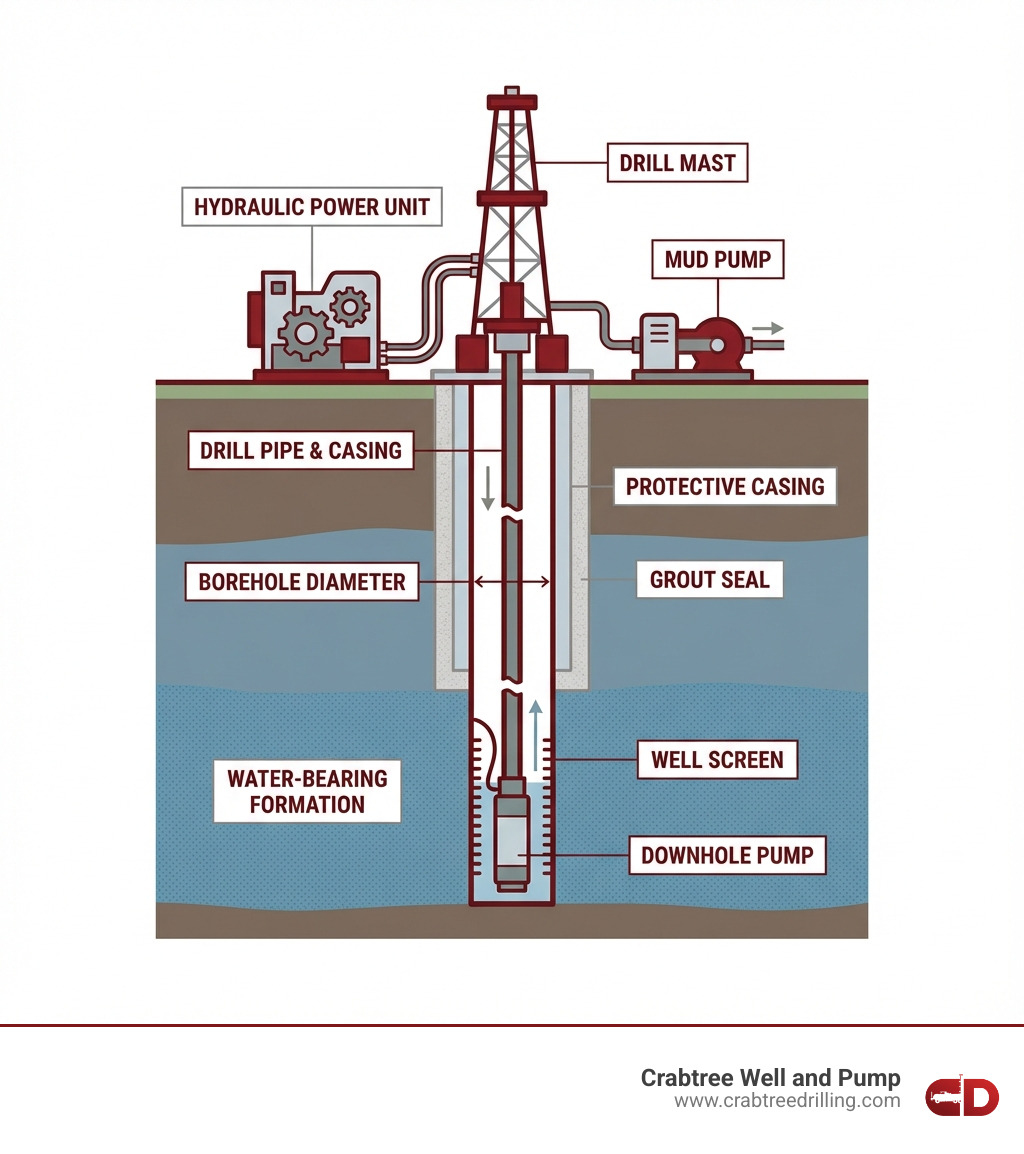
The Anatomy of a Well Drilling System
To truly appreciate the art and science of well drilling, we must first understand the sophisticated machinery that brings clean water to the surface. It’s a symphony of power, precision, and robust engineering, all working in harmony to tap into nature’s hidden reservoirs.
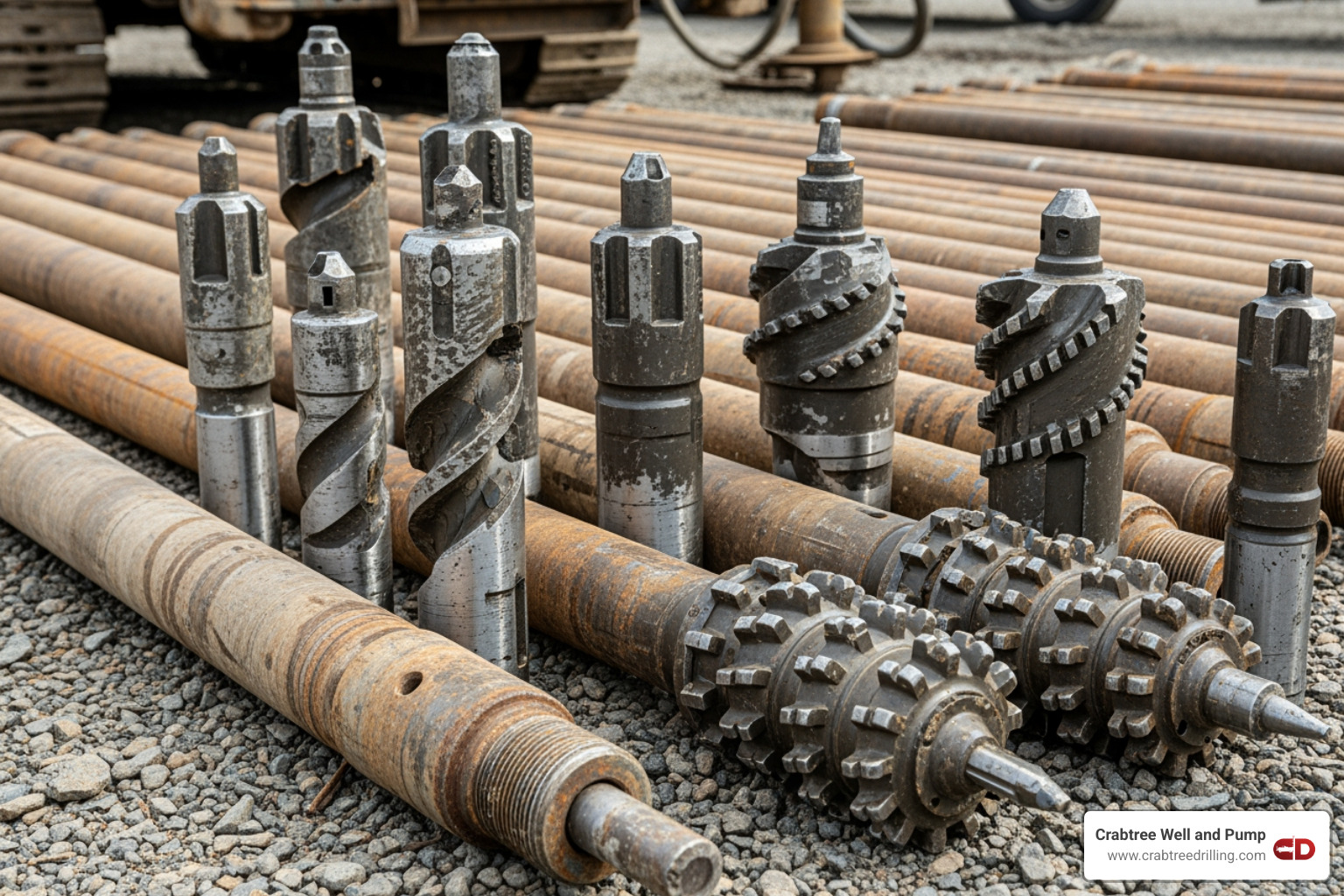
Core Components of Well Drilling Equipment
At the heart of any well drilling operation is the drilling rig itself. These powerful machines are designed to penetrate various geological formations, from soft soil to dense rock. While they come in different forms, their fundamental purpose remains the same: to rotate or percuss a drill bit into the earth.
The primary force behind modern rigs is often a robust power source, typically a diesel engine, which drives a sophisticated hydraulic system. This hydraulic power is the muscle of the operation, delivering the immense force needed for drilling. For decades, innovators in the field have been designing and building all-hydraulic, long stroke, tophead drive drilling rigs, a testament to the efficiency and reliability of this technology.
Beyond the rig, a complete well drilling setup includes essential support vehicles. Imagine trying to drill a well without enough water or the means to transport the necessary tools! That’s where water trucks and service trucks come in. Water trucks ensure a steady supply of water for drilling fluids and cooling, while service trucks carry additional drill pipe, bits, and repair parts, ensuring that work continues smoothly. For a deeper dive into the entire process, our Well Drilling Service Complete Guide offers comprehensive insights.
Essential Support Systems
While the drilling rig does the heavy lifting, it relies on a suite of specialized support equipment to function effectively. These systems manage the drilling fluids, clear cuttings from the borehole, and ensure the structural integrity of the well.
Here’s a list of essential support equipment for a typical drilling project:
- Mud Pumps: These are crucial for rotary drilling methods. They circulate drilling fluid (mud) down the drill pipe and back up the annulus, carrying rock cuttings to the surface and stabilizing the borehole. A powerful mud pump, capable of moving a high volume of fluid, can make a significant difference in drilling efficiency.
- Mud Cleaning Systems: Once the drilling fluid returns to the surface laden with cuttings, it needs to be cleaned and recycled. Mud cleaning systems, including shakers and tank systems, remove these solids, ensuring the drilling fluid maintains its optimal properties.
- Air Compressors: For air rotary or down-the-hole (DTH) hammer drilling, high-pressure air is indispensable. Air compressors, capable of delivering high volumes of air at high pressure, blast cuttings out of the borehole and power pneumatic hammers that pulverize rock.
- Grout Pumps: After drilling, the space between the well casing and the borehole wall (the annulus) must be sealed with grout to prevent surface contaminants from entering the well. Grout pumps are used to inject this sealing material, a critical step for water quality protection.
- Power Units: While many rigs have integrated power, additional power units may be used for ancillary equipment or during specific phases of the drilling process.
Downhole Tooling: The Cutting Edge
The drill rig might be the brain and brawn, but the downhole tooling is where the magic of earth penetration truly happens. These are the components that directly interact with the soil and rock, carving out the path for your water well.
- Drill Pipe: These are the hollow steel tubes that connect the drill rig to the drill bit. They transmit rotational energy and drilling fluid down the hole. Drill pipe comes in various dimensions and strengths, chosen based on the anticipated drilling depth and geological conditions.
- Drill Collars: Heavier and thicker than drill pipe, drill collars are placed directly above the drill bit. Their primary function is to provide weight on bit, which helps the drill bit penetrate hard formations more effectively. They also help keep the drill string in compression, preventing buckling.
- Drill Bits: The “teeth” of the operation, drill bits come in an astonishing array of designs, each custom for specific geological challenges.
- Rotary Bits: These include tri-cone bits (with rolling cones and carbide inserts) for various rock types and mill tooth bits for softer formations.
- Percussion Bits (DTH Hammers): Down-the-hole (DTH) hammers use compressed air to rapidly strike a carbide-tipped bit, pulverizing hard rock. They are highly effective in consolidated formations.
- Drag Bits: Simple, fixed-cutter bits often used in soft, unconsolidated formations like sand and clay.
- PDC Bits: Polycrystalline Diamond Compact bits are extremely hard and efficient for drilling in certain hard rock formations.
- Casing: Once the borehole is drilled, casing—a large-diameter pipe—is installed to prevent the borehole walls from collapsing and to isolate different geological layers. It also serves as the conduit for the pump.
- Well Screens: These are specialized sections of casing with precisely sized slots or perforations. They are placed opposite the water-bearing formation (aquifer) to allow water to enter the well while keeping sand and gravel out.
The design and manufacturing of these components adhere to rigorous standards, such as those detailed in API standards for drill stem elements, ensuring their reliability and interchangeability in the field.
Choosing Your Rig: Types and Configurations
Selecting the right well drilling equipment is akin to choosing the right tool for a specific job; it hinges on understanding the unique demands of your project. From vast agricultural fields to tight residential spaces in Springfield, Ohio, the perfect rig exists for every scenario.
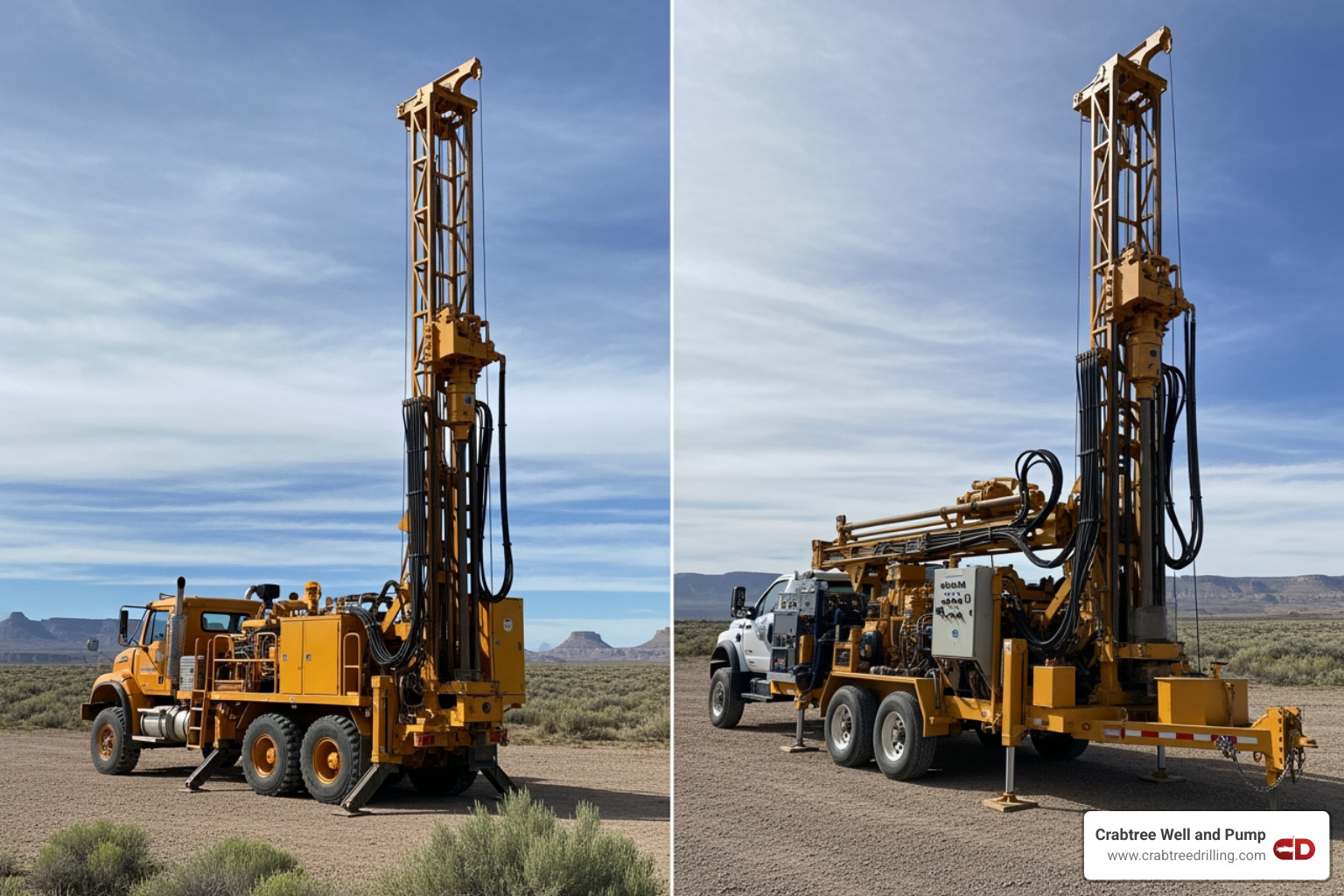
Trailer-Mounted vs. Truck-Mounted Rigs
The two most common categories of drilling rigs are trailer-mounted and truck-mounted, each with distinct advantages.
Trailer-mounted rigs are often praised for their portability and maneuverability. Some units offer a perfect balance of convenience, performance, and the ability to reach considerable depths for standard boreholes. Improved versions can reach even greater depths, even in demanding conditions. Their smaller footprint allows access to areas where larger vehicles simply cannot go, minimizing disruption to landscapes. Setup time can be quicker, and they are generally more flexible for diverse job sites.
Truck-mounted rigs, on the other hand, are the heavy-duty workhorses of the industry. They integrate the drilling equipment directly onto a robust truck chassis, making them self-contained and exceptionally powerful. Models can wield significant pushdown force and are built to tackle dense rock formations at significant depths. With immense pullback capacities, these rigs are designed for larger-scale projects, more challenging geology, and situations demanding maximum drilling efficiency. Their robust nature often means they can carry more onboard support equipment, such as high-capacity air compressors and mud pumps, allowing for longer continuous operations.
Here’s a comparison of these two types:
| Feature | Trailer-Mounted Rigs | Truck-Mounted Rigs |
|---|---|---|
| Mobility | High, easily towed by a standard vehicle | Moderate, self-propelled but larger footprint |
| Power/Capacity | Good for residential/light commercial, suitable for considerable depths | Excellent for heavy-duty, deeper wells, significant force |
| Footprint | Small, ideal for tight access and minimal site disturbance | Large, requires more space for operation and setup |
| Setup Time | Generally quicker | Can be longer due to size and stabilization requirements |
| Ideal Project | Residential wells, smaller irrigation, remote sites | Large commercial/industrial, municipal, deep agricultural wells |
Portable and Compact Drilling Rigs
Beyond the primary trailer and truck-mounted options, there’s a fascinating category of portable and compact drilling rigs designed for specific niches. These are the nimble heroes of tight access sites, often capable of being operated by a single person.
Imagine needing a well in a backyard with limited access, a hunting camp, or a garden where a large truck simply couldn’t maneuver without causing significant damage. This is where portable units shine. Many are designed for ease of use, with some manufacturers boasting that if you can operate a lawn mower, you can operate their rig. These units emphasize transportability, with some models designed to be broken down and palletized for convenient air or water transport, making them ideal for missionary work in remote areas, as we’ve seen in the Solomon Islands and Kenya.
While perhaps not drilling to the extreme depths of their larger counterparts, these rigs are perfectly suited for residential well drilling during home construction, offering a practical solution for homeowners seeking a self-sufficient water source. Our guide on What to Expect From Residential Well Drilling During Home Construction can provide more details.
Decoding Performance: Key Features of Well Drilling Equipment
Understanding the fundamental components and rig types is just the beginning. To truly appreciate modern well drilling equipment, we need to dig into the technical specifications that dictate a rig’s prowess and efficiency. It’s about knowing what makes these machines tick and how their capabilities translate into a successful well project.
Power and Force: Hydraulics, Pullback, and Pulldown
The sheer power and force a drilling rig can exert are paramount to its performance. This is where hydraulic systems truly come into their own.
Hydraulic power systems convert engine power into immense force, allowing for smooth, controlled, and efficient drilling. This technology has been a game-changer, enabling rigs to tackle increasingly challenging geological conditions. Pioneering companies have been building all-hydraulic rigs for many decades, demonstrating the reliability and effectiveness of this approach.
A key innovation is the direct-drive hydraulic feed system. Unlike older systems that rely on cables or chains, direct-drive hydraulics eliminate these components, leading to significantly reduced maintenance, fewer adjustments, and improved safety for the drilling team. This means less downtime and more productivity on the job.
Two critical metrics define a rig’s force:
- Pullback Force: This is the upward force the rig can exert to pull drill pipe out of the borehole. It’s essential for handling long strings of pipe, especially in deep wells, and for freeing stuck tooling. We see rigs with impressive pullback capacities, depending on the model and application.
- Pushdown/Pulldown Force: This is the downward force applied to the drill bit to facilitate penetration. High pulldown force is crucial for drilling through hard rock formations. Rigs can offer substantial pushdown force specifically for dense rock.
- Drilling Torque: This refers to the rotational force applied to the drill pipe and bit. Higher torque allows the bit to cut through harder materials more effectively. A rig might offer high levels of drilling torque, for example.
The impact of these powerful hydraulic systems on efficiency and productivity is profound. They boost drilling performance, accelerate operations, and allow us to tackle complex projects with confidence. For businesses, this translates into faster project completion and a better operational outcome, making commercial well drilling a smart decision. Find more about this in our article on the benefits of commercial well drilling.
Drilling Capacity: Depth and Borehole Diameter
A rig’s drilling capacity—its maximum depth and the range of borehole diameters it can achieve—is a fundamental consideration, directly tied to the specific needs of a well project.
- Maximum Drilling Depth: This varies widely based on the rig’s power and design. Compact portable rigs might reach considerable depths, while larger trailer-mounted units can go even deeper. Heavy-duty truck-mounted rigs, especially those designed for air or wet rotary drilling, can achieve very significant depths.
- Borehole Diameter Range: The diameter of the well is equally important. While a standard-sized borehole is common for many residential and smaller commercial wells, capable of reaching considerable depths, larger diameters are often required for higher-yielding wells. Our research shows that a standard casing can accommodate pumps delivering substantial water volumes. If higher yields are needed, a larger casing, requiring a wider borehole, would be necessary. This decision on casing size must be made before drilling begins, as it dictates the size of the pump that can be installed.
The influence of geology on these capacities cannot be overstated. Drilling through soft sand and clay is a different ballgame than penetrating dense granite. Rigs designed for hard rock will have higher pulldown force and more robust bits, while those for unconsolidated formations might prioritize fluid circulation and casing installation. Matching the rig’s capacity to the project needs and geological conditions is crucial for efficiency and success.
Advanced Features and Automation
Modern well drilling equipment isn’t just about brute force; it’s also about intelligence and efficiency. Advancements in technology have introduced sophisticated features that improve productivity, improve safety, and streamline operations.
One such innovation is automated rod handling. Manually adding and removing drill pipe sections can be physically demanding and time-consuming. Automated systems, like auto-indexing drill rod carousels that hold multiple drill rods, take the strain out of this process. These hands-free systems significantly reduce the physical effort required from the crew, minimize the risk of accidents, and speed up the overall drilling process.
While not universally adopted, some advanced rigs may also incorporate elements of remote operation and data logging systems. Remote operation allows drillers to control certain functions from a safe distance, particularly in hazardous conditions. Data logging systems continuously monitor drilling parameters such as depth, penetration rate, torque, and fluid pressure. This real-time data allows for immediate adjustments, optimizes drilling efficiency, and provides valuable information for future geological assessments.
The benefits of automation and advanced features are clear: improved safety by reducing manual labor and exposure to moving parts, and increased productivity through faster, more consistent operations. These innovations represent the ongoing evolution of well drilling equipment, making it more precise, safer, and more efficient than ever before.
Ensuring a Successful Project: From Safety to Final Testing
A successful well drilling project extends far beyond merely puncturing the earth. It encompasses rigorous safety protocols, thoughtful well development, and critical testing to ensure a reliable and sustainable water source for years to come. This comprehensive approach is what we at Crabtree Well and Pump are known for in Springfield, Ohio, and beyond.
Safety and Technological Evolution
Safety is always our paramount concern on any job site. Operating powerful well drilling equipment inherently carries risks, which is why modern rigs are equipped with numerous operator safety features, such as emergency stops and guarding around moving parts. Beyond built-in features, strict operational procedures and ongoing training are essential to protect our teams and anyone near the drilling site.
The technological evolution in well drilling equipment has significantly contributed to safer practices. For instance, the patented direct-drive hydraulic feed systems we discussed earlier not only boost efficiency but also improve safety by eliminating the need for cables or chains, which can be points of failure or mess. Similarly, the development of sonic drilling systems has brought about safer job sites by reducing the physical strain on teams and often creating a less intrusive drilling process.
Our team, much like the experienced professionals you’d seek out via “well drilling contractors near me,” prides itself on staying abreast of these advancements. We combine our decades of experience with the latest in reliable tools and equipment, ensuring that every project is conducted with the utmost safety and professionalism.
Well Development and Pump Testing
Once the drilling is complete and the casing and well screen are installed, the well isn’t quite ready for action. Two crucial steps remain: well development and pump testing. These processes are vital for maximizing the well’s yield and ensuring its long-term health.
Well Development: This is the process of cleaning the borehole and the surrounding aquifer. During drilling, fine sediment particles (fines) can enter the well and clog the natural pathways for water flow. Well development involves techniques like surge pumping, bailing, or air lifting to clear these fines and flush fine particles out of the gravel pack and aquifer. This improves the flow of water into the well, leading to a higher-yielding and more efficient water source.
Pump Testing: This is perhaps the most critical step in determining the true capacity of a new well. A pump test is performed to measure how much water can be pumped from the well on a sustained basis without depleting the aquifer. It involves installing a temporary pump and continuously pumping water at a constant rate for an extended period.
During the pump test, we carefully monitor the water level in the well. As water is removed, the water level drops, creating a “cone of depression” in the surrounding aquifer. We record the drawdown (the difference between the static and pumping water levels) at regular intervals until the water level stabilizes, indicating that the rate of water entering the well from the aquifer equals the rate of pumping.
From this data, we calculate the well’s specific capacity (Sc), which is the ratio of the pump rate to the drawdown at equilibrium. This metric tells us how efficiently the well produces water relative to the drawdown, providing a clear picture of its efficiency. By combining specific capacity with the maximum permissible drawdown, we can then determine the maximum sustainable discharge of the well, ensuring we don’t over-pump and stress the aquifer.
These steps for proper well development and testing are essential to guarantee a reliable and long-lasting water supply. For more detailed insights, the Steps for proper well development and testing resource provides an excellent overview.
Frequently Asked Questions about Well Drilling Equipment
How do different soil and rock conditions influence the choice of drilling rig and techniques?
The geology of a site is the most critical factor. Soft soils like sand and clay may be handled by auger or mud rotary methods with less powerful rigs. Hard rock formations require rigs with high pulldown force and the use of air rotary or down-the-hole (DTH) hammer techniques. The choice of drill bit is also directly tied to the ground conditions.
What are the main applications for this equipment beyond water wells?
Modern drilling rigs are versatile. Besides Water Well Drilling Ohio, they are widely used for geothermal heating and cooling system installations, environmental testing and monitoring wells, mineral exploration, and geotechnical investigations for construction projects.
How does the choice of drilling rig impact the overall project timeline?
A rig’s power, efficiency, and suitability for the site’s geology directly affect project speed. A powerful, well-matched rig with features like automated rod handling can significantly reduce drilling time. Conversely, an underpowered rig or one requiring difficult site access can lead to longer project durations.
Your Partner for Professional Well Drilling
Understanding the different types of well drilling equipment and their features is the first step toward a successful project. From compact, portable units to powerful truck-mounted rigs, the right machinery ensures access to a clean, reliable water source. For decades, Crabtree Well and Pump has combined this technical knowledge with hands-on experience to serve our community. If you have questions or need expert service for your water well project, our team is ready to help.
Contact us for your well drilling needs